“Coco, coco, coco.” “Banana, banana, banana.” Sébastien looks at Matthieu.
“It feels like we’re in *Minions*.” Matthieu bursts out laughing.
Across from us, our captain smiles from his small, round bamboo boat.
His English is limited, and for the past few minutes, our conversation has consisted mainly of “coco,” “banana,” and big gestures.
He takes us through the mangroves, shows us how to catch crabs with a piece of dead fish on the end of a line, and makes a little crown out of leaves.
On paper, we’re right in the middle of one of Hoi An’s most touristy attractions. In reality, we’re almost alone and having a great time. A contradiction that ultimately sums up our stay quite well. Hoi An is a few dozen kilometers from Da Nang, and many travelers choose to come here just for the day. We decided to stay for four nights. By the very first evening, we knew we’d made the right choice. After the high-rises and wide avenues of Da Nang, the scenery changes completely. Low-rise houses with yellow facades and wooden shutters line the streets of the old town.
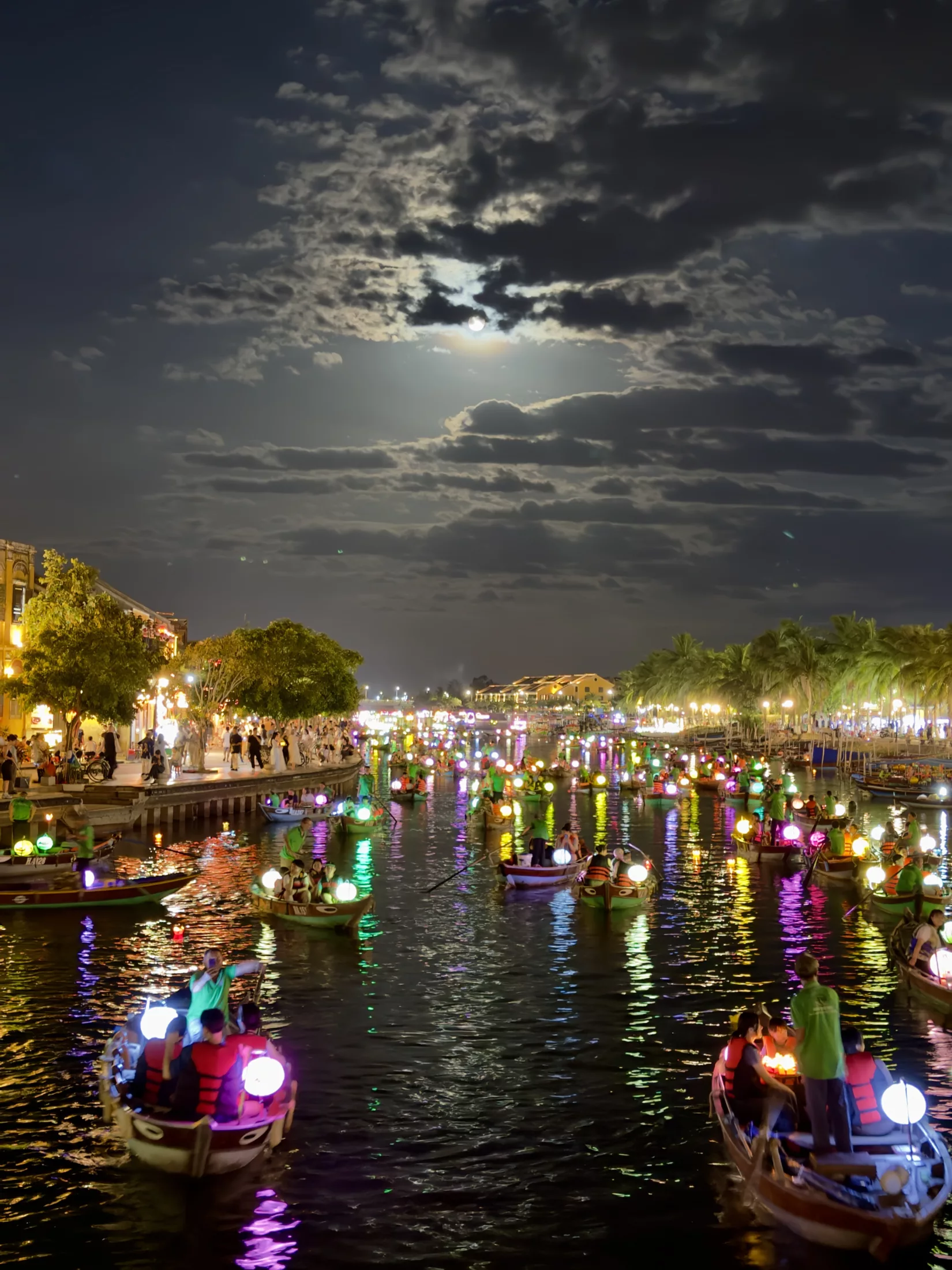
Everywhere, lanterns hang from the facades, above the narrow streets, in restaurants, and even on boats. Blue, pink, red, green, yellow, and purple, they gradually transform the city as night falls. Vietnamese tourists and Western travelers mingle in the streets. In the evening, everything converges on the Hoài River. Dozens of small boats covered in lanterns move slowly along the water. On our very first evening, we boarded one of them. The ride is very short and costs almost nothing, but it’s an attraction in its own right. We’re given a small paper lantern with a candle inside; we make a wish before setting it adrift on the water and watch it drift away among the others. We loved the experience so much that we even did it again on our last night.
Objectively speaking, not much happens during those few minutes. And yet, being in the midst of all those illuminated boats is enough to make the moment quite magical. The evening continued without any real plan. We stop at a small bar where a couple is performing live. There are very few customers. When they realize we speak French, the opening notes of Gilbert Montagné’s “On va s’aimer” begin. The melody—no doubt about it. The lyrics, on the other hand, have clearly taken quite a journey from France to Vietnam.
We recognize the song well enough to know what they’re supposed to be singing, but not always what they’re actually singing. With almost no one else in the bar and their very Vietnamese-sounding French, it’s practically like having our own private concert. A little later, on our way back to the hotel, a rainbow flag catches our eye in front of a small bar that opens onto the street. We stop. The place is called the Pip Bar. We order two cocktails, and as we scan the menu, we spot “mango sticky rice.” Perfect—we’ll even end the evening with a little dessert. Except that we’re in a cocktail bar.
And the “mango sticky rice” is also a cocktail. The result: three cocktails instead of two, and still no dessert. Luckily, the liquid version is pretty good. We also immediately fell in love with the place—its little terrace opening onto the street and its laid-back vibe.
What was supposed to be an impromptu nightcap ended up becoming one of the spots we’d return to throughout our four-day stay.
In fact, it’s by returning to the same streets every evening that we begin to notice Hoi An’s quirky tourist dynamics.
Everyone is taking photos of everything. In front of some lantern shops, the backdrops are so perfect they almost seem to have been built for Instagram. And sometimes, that’s literally the case. For 10,000 dongs—a few dozen cents—you can go inside and use the wall of lanterns as a backdrop.
After more than a month in Vietnam, we’re perhaps starting to get used to this kind of setup, but this one strikes us as rather clever. The shopkeeper makes a little money, the visitor can take photos at their leisure without disturbing anyone, and no one has to pretend they’re there to buy a lantern. It’s all perfectly commercial and perfectly open about it. And yet, the result is still beautiful. In Hoi An, we’re slowly starting to wonder if tourism and charm really have to be at odds.
This impression also comes from the people. Some restaurant owners are particularly friendly and touchy-feely, especially with Matthieu, whose arms seem to attract a fairly constant amount of attention. They’ll touch his arm to talk to him, then again a few minutes later. It ends up being quite amusing to us. Behind the tourist routine, interactions often remain surprisingly spontaneous. Our hotel also gives us an excellent reason not to turn these four days into a marathon.
For a practically negligible sum, we discover a contemporary hotel with an infinity pool overlooking the rice fields, a gigantic room with a lovely view, an extremely comfortable bed, and free bikes. In the morning, breakfast is gargantuan and delicious. We do a little exercise, play a few games of pickleball, spend plenty of time in the pool, and head back to the old town every evening. For once, we’re not trying to pack our days full. The bikes also take us through the rice paddies to the famous coconut boats.
We expected to find a highway of round boats packed with tourists. Yet the departure points are so scattered that we only come across two other visitors for much of the ride. That’s when our very elaborate conversation about “coco” and “banana” began. Our captain showed us how to catch crabs, made us a little crown out of leaves, and then revealed another passion: Rasputin. The song starts, he hums along as best he can and improvises a little dance on the edge of the boat. A few minutes later, our boat is spinning around at full speed. Our stomachs aren’t too thrilled.
We, on the other hand, are having a blast. Then the music stops. He points at himself. “Tip, tip.” We burst out laughing.
After Rasputin, the dance, and the boat spinning around—at least things are clear. The timing is impeccable. Even the exit is perfectly orchestrated. Another boat takes pictures of us with him, and a few minutes later, our photos are ready. About fifteen photos for less than three Swiss francs. Once again, we’re not quite sure if we’ve just experienced a small, rustic boat ride or a perfectly polished tourist attraction.
Probably both.
A few kilometers further on, we try another experience whose name pretty much sums up the concept: the Duck Leader.
In the middle of the rice paddies, several flocks of ducks await their visitors.
The activity involves becoming, for a few minutes, their makeshift leader.
We’re given some seeds, we start walking, and the whole flock immediately follows in a cheerful, coordinated movement.
The setting seems very rural, but the operation is perfectly organized. Several groups move side by side, each with its own guide and its own ducks. For about twenty minutes, our flock follows us with a pretty simple motivation: to grab the seeds we’re handing out. Then our guide decides to tweak the rules a bit and pours the seeds right onto our feet. In a matter of seconds, our feet disappear beneath the ducks.
The beaks peck away; it tickles, and it’s impossible to move without risking stepping on one. Matthieu loves it. Sébastien discovers that there’s apparently a maximum number of ducks that can comfortably gather around his feet. After that, we wash and disinfect our feet, and once back at the hotel, we wash them a second time as a precaution. Hoi An even takes tourism a step further by letting you leave with something made just for you.
Sébastien is determined to try out one of those shops that can make custom leather shoes in a single day. We choose the style, the leather, the color, and have our feet measured.
We settle on sandals heavily inspired by a certain well-known German model. Let’s call them “Birken-almosts.” The next day, they’re ready. Then comes the full moon.
And it’s that evening that all our impressions from the previous days finally come together.
Part of the electric lighting in the old town fades away, and lanterns take over the streets. They hang above our heads, fill the boats, and are reflected in the river. Small paper lanterns drift on the water between the boats. There are huge crowds.
Huge numbers of boats. Huge numbers of phones held aloft to take photos. And it’s magnificent. It’s almost counterintuitive. You could remove half the visitors and have a quieter old town. Take thirty boats out of the river and make the experience more peaceful.
Get rid of the photo-op shops and have something less commercial.
But would it really be more beautiful?
That evening, we weren’t so sure anymore. It is precisely all those illuminated boats that transform the river into a vast mosaic of colors. All those clustered lanterns that make the streets seem almost unreal. Tourism is no longer content to merely be part of the scenery. In some places, it directly contributes to creating it.
And yet, behind it all, something else continues.
In front of certain houses and shops, we notice trays of food, incense, and offerings—particularly those related to ancestors and local spiritual beliefs. A few meters away, a family sets out its offerings while visitors board boats decked out in lights. These two realities aren’t hidden one behind the other.
They occupy the same streets.
Maybe that’s why four nights in Hoi An ultimately seem almost too short to us.
We didn’t fill our days with sightseeing or try to see everything.
We rode bikes, lounged by a pool overlooking the rice paddies, accidentally ordered a dessert, listened to Gilbert Montagné singing in broken French, let ducks peck at our feet, and took a little boat ride a second time simply because it was beautiful.
We thought we might like Hoi An despite its mass tourism.
In the end, we actually liked it at times because of it.
And that was something we really didn’t expect.