We’re not entirely sure why, but cities by the sea almost always seem easier to fall in love with. Sometimes all it takes is a beach instead of a park, a bridge stretching across a bay, or a glimpse of the horizon between skyscrapers for a big city to suddenly feel a little more like a holiday destination. That was exactly the feeling Busan gave us.
And yet, Busan is anything but a small seaside town. The city is enormous, sprawling across hills, bridges, and islands, with one of the country’s largest commercial ports and neighborhoods that can easily be an hour apart by public transport. But wherever you go, the sea is never far away. A beach appears at the foot of a cluster of skyscrapers, followed by a coastal walkway, a cliffside viewpoint, or a temple overlooking the ocean. Inevitably, it changes the way the city feels.
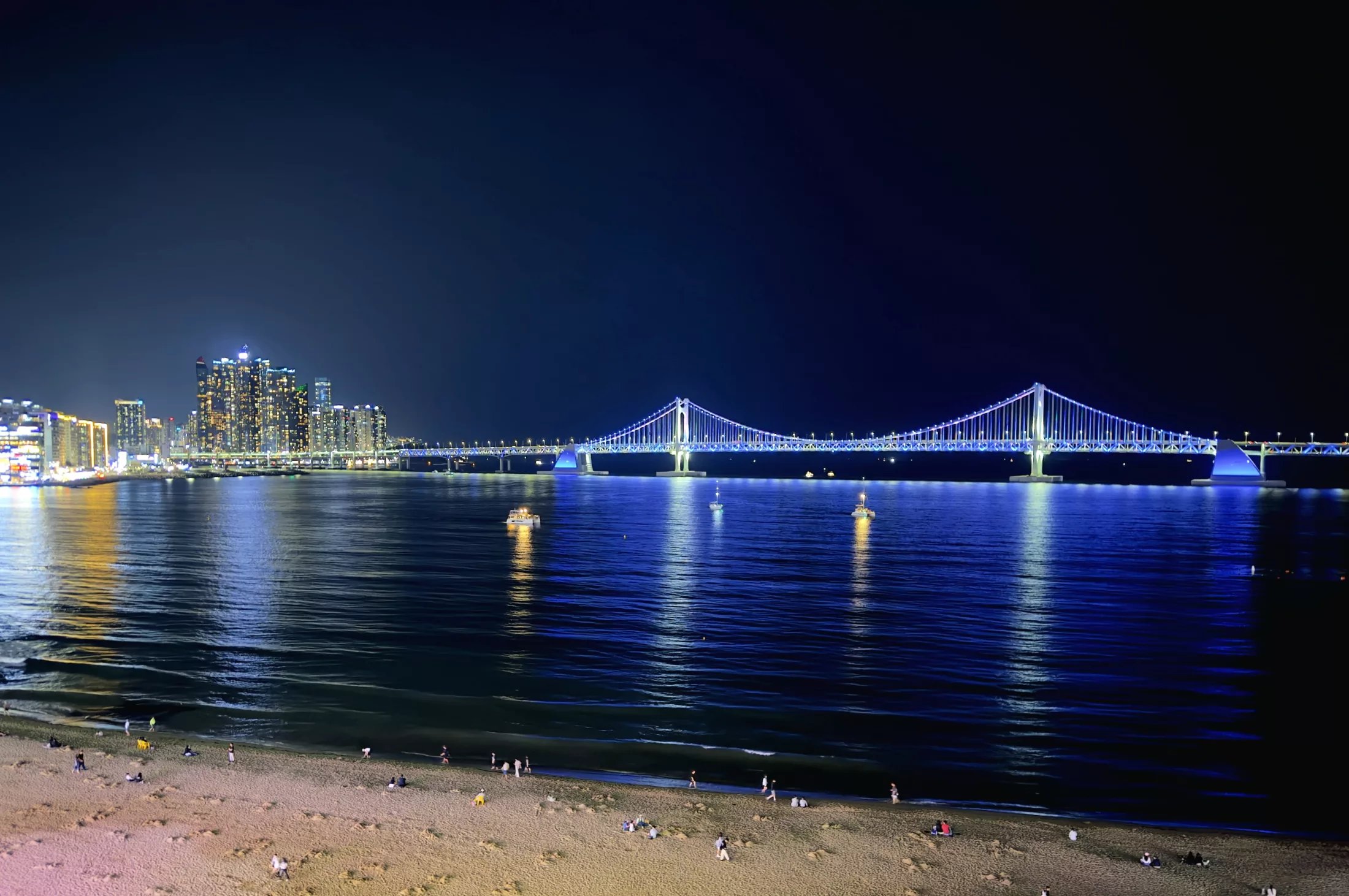
Our first introduction to Busan is through Gwangalli, the neighborhood where we decided to stay. It doesn’t take long for us to fall for it. A wide promenade runs along the beach, lined with restaurants, cafés, shops, and arcades, while the impressive Gwangan Bridge stretches across the bay right in front of us. After sunset, the bridge lights up, changing colors throughout the evening, and the towers surrounding the beach begin to glow as well.
People gather on the sand, families stroll along the waterfront, and small fireworks regularly appear around the bay. We are clearly in the middle of a major city, yet the beach serves almost the same purpose that a large park would elsewhere. People come here to walk, eat, chat, or simply sit by the water. It’s a simple thing, but it creates an atmosphere that is immediately appealing.
Out of curiosity, we also spend part of that first evening exploring Busan’s small LGBT scene at Banana Busan, one of the city’s gay bars. It’s a Sunday, so the venue is particularly quiet, but we’re still happy to see that such a scene exists here too, even if it remains far more discreet than in many of Asia’s larger capitals.
The next day brings a complete change of scenery as we head to Gamcheon Culture Village. Before becoming one of Busan’s most photographed attractions, Gamcheon was a poor hillside neighborhood that became home to many refugees during and after the Korean War in the 1950s. Starting in 2009, a major urban art project gradually transformed the area, and today its colorful houses, murals, and stairways attract visitors from all over the world.
The viewpoints are beautiful, but what we enjoy most is quickly leaving the main tourist routes behind. For hours, we wander through narrow alleyways and staircases winding between the houses. Around every corner there seems to be a hidden mural, a sculpture, a tiny passageway, or a café with sweeping views over the neighborhood. At times, it feels like a treasure hunt.
We even spend a few minutes chatting with a resident who personally decorated part of the wall outside his home. That’s also what makes Gamcheon interesting. Despite the cafés, souvenir shops, and visitors, it doesn’t feel like a place created purely for Instagram. People still live here, and the neighborhood’s transformation has also brought new economic opportunities to an area that had long remained on the margins of the city’s development.
Later, we make our way down to Gukje Market, where the atmosphere is completely different. The busy shopping streets, markets, and food stalls may be less photogenic than Gamcheon, but they feel far more alive. It’s also the day we begin to understand one of Busan’s biggest challenges: distance. On a map, neighborhoods can appear surprisingly close, but in reality the city is so spread out that it’s easy to spend a long time switching between metro lines, buses, and connections. We quickly learn that it’s far more practical to organize each day by area rather than trying to cross Busan multiple times.
The following day, we finally experience one of the attractions we had been most excited about: the Sky Capsule. Small colorful cabins glide slowly above the coastline between Mipo and Cheongsapo, with the sea constantly by your side. We booked a little too late and the most popular direction was already sold out, so we simply chose to travel the other way.
In the end, we had no regrets. Approaching Haeundae little by little, with the beach and skyscrapers gradually coming into view, is spectacular, and there are noticeably fewer people. We also appreciate that there’s no need to return by capsule. A coastal path follows almost the entire route, allowing you to walk back at your own pace with uninterrupted sea views. The Beach Train follows much of the same coastline. Once again, we find ourselves in the middle of a huge city, yet our afternoon activity is simply walking beside the ocean.
On another day, we hop aboard Busan’s sightseeing buses to see the city from a different perspective. It’s probably then that we truly realize just how vast Busan is. Sitting on the open-air upper deck, we finally cross the famous Gwangan Bridge that we had admired every evening from Gwangalli.
A few minutes later, the scenery changes dramatically. Cranes, industrial facilities, and endless rows of shipping containers come into view as we pass the Port of Busan, the largest port in South Korea. The contrast is striking. Moments earlier, we were watching people stroll along a beach. Now we find ourselves at the heart of one of the country’s most important maritime trade hubs. In Busan, the sea isn’t simply part of the scenery. It is one of the reasons the city exists and thrives.
The bus then takes us to Yeongdo, where we visit Huinnyeoul Culture Village, sometimes nicknamed the “Santorini of Busan.” To us, the comparison feels a little ambitious. The seaside walkway is pleasant and some cafés enjoy exceptional locations, but unlike Gamcheon, the place doesn’t leave a lasting impression on us.
We continue to Taejongdae, at the southern tip of the island. The area features coastal forests, cliffs, and sweeping ocean views. We had imagined a genuine nature hike, but much of the route actually follows paved roads also used by the tourist train. It’s not exactly a wilderness adventure by Swiss standards, but it remains an enjoyable walk and reveals yet another side of Busan’s coastline.
For our final major visit, we cross much of the city to reach Haedong Yonggungsa. Unlike many Korean temples hidden in the mountains, this one sits directly beside the ocean. As we descend the staircase toward the complex, the colorful rooftops seem almost perched on the rocks, with the sea stretching out behind them.
There are plenty of visitors, but the setting remains genuinely impressive. Statues, lanterns, and Buddhist buildings blend with the sound of crashing waves. After visiting several temples throughout Korea, this is the one that stays with us the most, largely because its surroundings completely transform the experience.
Our final evening naturally brings us back to where everything began: Gwangalli. We are sitting by the sea enjoying an ice cream when two particularly well-dressed men approach a Western traveler sitting nearby. After a few sentences and the way they introduce themselves, we instantly recognize the same type of religious recruiters who had caught our attention at the beginning of our trip through Korea.
We hadn’t encountered them once since then, and somehow they choose our very last evening in the country to reappear right in front of us. The coincidence makes us laugh. Our Korean journey is ending almost exactly the way it began.
After five nights, we understand why Busan won us over so quickly. It is a huge metropolis, with a major port, dense neighborhoods, and long travel times, but the sea constantly changes the atmosphere. Between two districts, you suddenly come across a beach, a bridge, an island, or a stretch of coastline, and locals use the waterfront much like residents of other cities use their large parks.
Maybe that’s simply what draws us to coastal cities. They can be huge, noisy, and intensely urban, yet all it takes is the sight of the ocean at the end of a street to make it feel as though a holiday is never far away.
In Busan, that feeling followed us almost everywhere.